
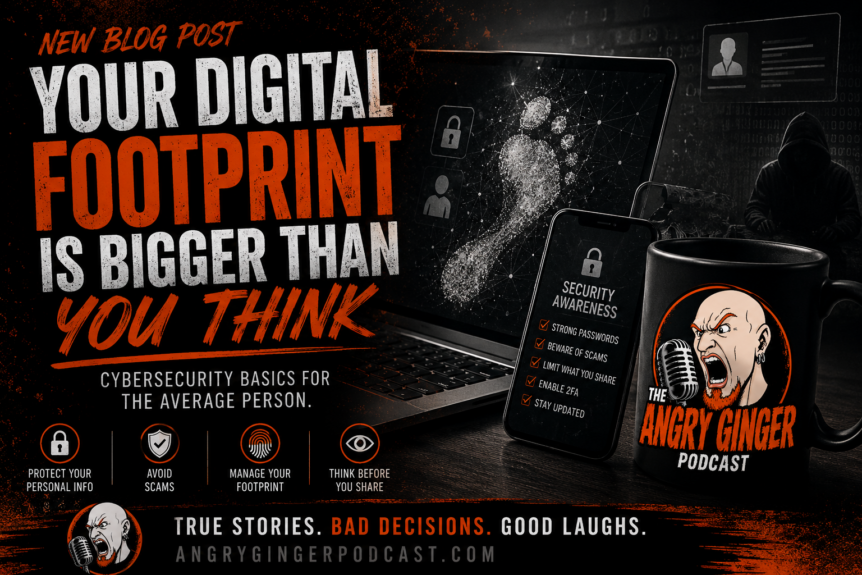
The Internet Never Really Forgets
There’s a lot we do every single day without giving much thought to the digital trail we leave behind.
We search for things. We shop online. We post pictures. We comment on social media. We sign up for websites, download apps, accept cookies, and click “I agree” without reading a damn thing.
Most of us aren’t thinking about cybersecurity when we’re doing it.
And that’s exactly the problem.
On the latest episode of The Angry Ginger Podcast, I decided to take a step away from the usual bullshit and talk about something that affects pretty much everyone who owns a phone, uses a computer, or spends any amount of time online: your digital footprint.
And no, this isn’t going to be some boring lecture about cybersecurity terminology that makes your eyes glaze over.
This is about the stuff the average person actually needs to understand.
What Exactly Is a Digital Footprint?
Think of your digital footprint as the trail you leave behind every time you interact with the internet.
Some of that information is obvious.
You post something on Facebook? That’s part of your digital footprint.
You upload a picture to Instagram? Digital footprint.
You leave a review for a restaurant, comment on a YouTube video, create an account on a website, or send a message through an app?
Yep.
But there is also a whole other side of your digital footprint that you may not even realize you’re creating.
Websites can collect information about your device. Apps can collect information about how you use them. Companies can track browsing behavior, purchases, locations, preferences, and other information that helps them build a picture of who you are.
And here’s the part that should make you stop and think:
Your digital footprint can say a hell of a lot about you.
“But I Don’t Have Anything to Hide”
I’ve heard that argument plenty of times.
“I don’t have anything to hide, so I don’t care.”
That’s not really the point.
You don’t have to be doing anything illegal, embarrassing, or scandalous for your information to be valuable.
Your name, email address, phone number, birthday, location, purchasing habits, usernames, passwords, photographs, and social connections can all be useful to somebody.
Sometimes that somebody is a legitimate company trying to sell you something.
Sometimes it’s an advertiser trying to figure out what makes you tick.
And sometimes it’s somebody who wants to use that information against you.
Scammers don’t necessarily need one giant piece of information about you.
Sometimes they just need enough small pieces to put the puzzle together.
Cybersecurity Isn’t Just a “Tech Guy” Problem
One of the biggest misconceptions about cybersecurity is that it’s something only businesses and computer nerds need to worry about.
It isn’t.
You don’t need to know how to write code.
You don’t need to understand how encryption works.
You don’t need to be able to build a computer from scratch.
You just need to understand some basic principles.
Use strong, unique passwords.
Turn on two-factor authentication when it’s available.
Don’t blindly click links in emails or text messages.
Be suspicious when somebody creates a sense of urgency.
Don’t give strangers information they don’t actually need.
Keep your devices and apps updated.
And for the love of God, stop using the same password for everything.
If somebody gets that password, you’ve potentially handed them the keys to your entire digital life.
The Scammers Are Getting Better
The days of the Nigerian prince email are still alive and well, but scams have evolved considerably.
Scammers can make emails and messages look incredibly convincing.
They can impersonate banks, government agencies, delivery companies, employers, friends, family members, and even people you know personally.
And with artificial intelligence becoming more accessible, creating convincing fake messages, images, audio, and video is becoming easier.
That means our best defense isn’t necessarily becoming a technology expert.
It’s becoming more skeptical.
Take a second.
Look at the email address.
Check the website.
Don’t let somebody rush you into making a decision.
If something feels wrong, stop and verify it through a separate channel.
That extra 30 seconds could save you a hell of a lot of trouble.
And Then There’s Social Media
Here’s where things get really interesting.
We willingly put an enormous amount of our lives on the internet.
Where we’re going.
Who we’re with.
Where we work.
Where we live.
What we drive.
Where we’re vacationing.
When we’re going to be out of town.
Sometimes we’re basically handing strangers a blueprint of our lives.
And I’m not saying everyone needs to delete their social media accounts and disappear into the woods.
But maybe think twice before posting every detail of your life publicly.
There’s a difference between sharing your life and broadcasting information that somebody could use against you.
The Point Isn’t to Be Paranoid
I don’t want anybody listening to this episode to walk away thinking the internet is some giant evil machine waiting to steal your identity.
The internet is an incredible tool.
It allows us to communicate, learn, work, entertain ourselves, build businesses, and connect with people we’d never otherwise meet.
The point isn’t to be afraid of technology.
The point is to understand it.
We lock our doors at night.
We don’t hand our wallet to a random stranger.
We don’t give somebody the keys to our house because they asked nicely.
Our digital lives deserve the same basic level of common sense.
Your Digital Life Is Still Your Life
Maybe that’s the biggest takeaway from this episode.
We tend to think of our online lives as somehow separate from our “real” lives.
They’re not.
Your reputation online can affect your career.
Your online relationships can affect your personal life.
Your accounts can contain financial information.
Your phone can contain photographs, conversations, passwords, contacts, and years of personal history.
That’s a lot of your life sitting inside a device that you carry around in your pocket every day.
So maybe it’s time we start treating our digital security with the same seriousness we give everything else we care about.
Because whether you realize it or not, you’ve already left footprints.
The question is:
Who can see them, and what can they learn from them?
Listen to the latest episode of The Angry Ginger Podcast for the full conversation — and as always, expect some opinions, some common sense, and probably a little bit of bullshit along the way.
True stories. Bad decisions. Good laughs.
That’s The Angry Ginger Podcast.